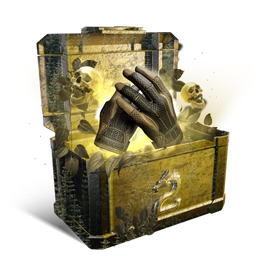
Unlocking Success: The Art of CS2 Case Opening
The Ultimate Guide to CS2 Case Opening: Odds, Economics, and Mechanics
Counter-Strike 2 (CS2) has captured the attention of millions worldwide, continuing the legendary tactical shooter franchise with upgraded graphics, responsive smoke grenades, and a heavily refined tick-rate system. Yet, alongside the competitive gameplay, a massive parallel economy thrives: weapon finishes, or “skins.”
At the center of this economy lies the classic ritual of the CS2 case opening. For many, the spinning wheel of a weapon case provides an unmatched rush of adrenaline. However, beneath the flashing lights and glowing golds lies a strict mathematical reality. This guide explores the mechanics, odds, and economic considerations behind opening cases in CS2.
Understanding the Mechanics: How Case Opening Works
To participate in a case opening, a player needs two things: a Weapon Case and a corresponding Key.
Cases drop randomly while playing on official Valve servers, or they can be purchased directly from the Steam Community Market. Keys, on the other hand, cannot be traded immediately upon purchase and must be bought directly in-game or via the Steam Market for a fixed price (typically around £2.50 GBP).
Once the key is used on the case, a spinning animation reveals a random item from that case’s predefined loot pool. The item is instantly added to the player’s inventory, ready to be kept, traded, or sold.
CS2 Drop Rates and Odds
Valve is legally required in certain regions to disclose the probabilities of receiving items of varying rarities. While the exact odds for individual skins within a tier are generally weighted evenly (minus the special rare item), the tier-based drop rates are fixed.
| Item Rarity Tier | Approximate Drop Rate | Visual Representation |
|---|---|---|
| Mil-Spec (Blue) | ~79.92% | Standard, common drops |
| Restricted (Purple) | ~15.98% | Uncommon drops |
| Classified (Pink) | ~3.20% | Rare drops |
| Covert (Red) | ~0.64% | Extremely rare drops |
| Special Rare (Gold/Knife/Gloves) | ~0.26% | The ultimate jackpot |
As the table clearly shows, the chance of unboxing a knife or pair of gloves is roughly 1 in 385 (0.26%).
The Economics of Unboxing: Why the House Usually Wins
From a pure financial standpoint, opening CS2 cases is a negative-expected-value activity. Statistical analysis of millions of opened cases consistently reveals that the average return on investment (ROI) sits well below 100%—often fluctuating between 40% and 60% depending on current market fluctuations.
Factors Influencing Skin Value
- Float Value (Wear): Items range from Factory New (FN) to Battle-Scarred (BS). Lower float values generally command higher prices.
- StatTrak: A built-in counter that tracks kills with the weapon, adding a multiplier to the skin’s value.
- Pattern Templates: Certain skins (like the Case Hardened series) have different pattern indexes that dictate the amount of blue on the weapon, drastically altering its market price.
Because the vast majority of drops are low-tier blue items worth pennies, players almost always lose money on a single-case or small-batch opening. The economy relies on the “lottery effect”—the few who hit rare knives subsidize the excitement for the many who pull common weapon finishes.
Best Practices and Responsible Openings
For those who view case openings as a form of entertainment rather than an investment strategy, certain guidelines can help manage expectations and protect finances:
- Set a Strict Budget: Decide on a fixed monthly entertainment budget for cases and never exceed it. Treat the money spent as the cost of a ticket to a lottery or a movie, not as an investment.
- Buy Singles Instead: If a specific skin is desired, purchasing it directly from the Steam Market or third-party marketplaces is almost always cheaper than trying to unbox it.
- Avoid the “Gambling Fallacy”: Cases are completely independent random events. Opening 100 cases without a knife does not increase the odds of pulling one on the 101st case.
- Beware of External Scams: Never log into third-party gambling or trading sites using credentials through unverified links. Stick to official platforms and trusted marketplaces.
Frequently Asked Questions (FAQ)
Can you make a profit by opening CS2 cases?
Statistically, no. While individual players occasionally get lucky and unbox a high-tier knife or glove worth hundreds or thousands of dollars, the vast majority of openings result in items worth significantly less than the cost of the key.
Are CS2 cases rigged?
No. The odds are strictly governed by predetermined drop rates set by Valve. Every single case opening is an independent event determined by a pseudo-random number generator (RNG) at the moment the key is applied.
What happens to old CS2 cases?
When Valve introduces a new case, older cases often move to the “rare drop pool.” This means they drop extremely infrequently after matches, which can cause their market prices to appreciate over several years due to decreasing supply.
What is the difference between CS:GO cases and CS2 cases?
Mechanically, the case-opening system carried over directly from Counter-Strike: Global Offensive to Counter-Strike 2. However, skins often look significantly more vibrant and detailed in CS2 due to the Source 2 engine’s updated lighting and material rendering systems.
CS2 case openings remain a thrilling cultural phenomenon within the gaming community. Whether you are chasing the elusive golden knife animation or simply enjoy collecting unique finishes for your loadout, understanding the mathematics behind the spins is crucial. Approach case openings with caution, set strict financial boundaries, and remember that the true value of Counter-Strike lies in the competition, teamwork, and gameplay.
Try CS2 Case Opening on CS2Skin to uncover CS2 skin possibilities, enjoy a smooth experience, and chase standout virtual drops.